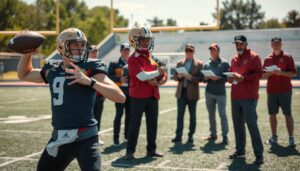
Remember when coaches sold recruits on tradition, education, and NFL dreams? They do it now, but with a twist. The pitch is now set against the sound of a cash register.
The way we talk about recruiting has changed. It’s no longer just about loving the program. Now, the first thing asked is “What’s your number?” It’s all about the money.
This new era has turned recruitment into a business deal. Stories of athletes demanding millions are common. Collectives act like shadow payroll teams, spending millions to build a team. It’s all about the money, not just talent.
Every meeting feels like the start of a business deal. The recruiting game is changing fast, moving towards NIL revenue share agreements. It’s not just about playing the game anymore. It’s about making deals in the boardroom.
Notable FSU NIL Deals
The real NIL excitement at Florida State isn’t just one big deal. It’s the quiet work behind the scenes. In this new world, player deals are just the tip of the iceberg. The real story is the fund that makes it all happen.
Rising Spear, FSU’s main NIL collective, is a big player. It aimed to raise $7 to $10 million in 2022. Think of it as a team manager, not just a sponsor. It’s all about building a financial base for the real deals.

Is $10 million enough? Let’s examine it closely. In the ACC, it might get you noticed. But against the SEC and other boosters, it’s like bringing a knife to a gunfight. It’s not just about the money. It’s about what makes a deal stand out in a crazy market.
To understand FSU’s situation, we need to see the bigger picture. Here’s how the Seminoles compare to the early NIL arms race.
| Program | Collective | Reported Fund Goal (2022) | Notable Deal Focus |
|---|---|---|---|
| Florida State | Rising Spear | $7-10 Million | Collective war chest for roster-wide distribution |
| Texas | Clark Field Collective | $10 Million | Initial war chest for broad roster support |
| Florida | Gator Guard | $20 Million | Aggressive fund targeting top-tier recruiting classes |
| Miami | N/A (Booster John Ruiz) | N/A | Individual basketball transfer: $400k/year |
The table shows a clear picture. For FSU, Texas, and Florida, it’s all about the size of the collective. Miami’s John Ruiz, on the other hand, made a splash with a $400,000 deal for a basketball transfer. That’s a game-changer.
With top recruits reportedly earning $100,000 a year, $10 million doesn’t stretch as far as you’d think. It might cover a few dozen players. But what if your rival has twice as much? It’s not about one player deal. It’s about outspending the competition.
This raises a big question. What does “notable” mean today? At FSU, it’s about Rising Spear’s ambition and structure. It’s a big-picture approach. Yet, we’re drawn to the big, flashy contracts. The truth is, both are important. The collective fund is the engine, and the individual deal is the noise. You need both to succeed.
So, while Ruiz’s deal gets all the headlines, FSU’s fund is the real strategy. One makes a splash, the other builds a foundation. In the long run, which is more important? It depends on whether you’re reading the news or the books.
Compliance and Culture
If the NCAA’s compliance manual was a movie, it would be a dusty western. The sheriff’s badge is made of plastic, and the outlaws have better lawyers. Welcome to the NIL era, where the rulebook tells a different story.
Oklahoma State’s football helmets had a plan to feature QR codes linked to player NIL deals. It was a modern marketing idea, but the NCAA said no. They cited a bylaw from before QR codes existed. It’s like trying to govern a digital gold rush with old laws.
This gray area is where the real action is. Schools and collectives have “constant communication,” a careful dance. The irony is thick. Booster payments, once banned, are now legal if structured right.
| Aspect | The Old Crime (SMU Era) | The New Transaction (NIL Era) |
|---|---|---|
| Method | Under-the-table cash, cars, apartments | Publicly announced brand deals, endorsements |
| Enforcement | NCAA investigations, program sanctions | Minimal oversight, legal gray areas |
| Public Perception | Scandalous, unethical | Entrepreneurial, market-driven |
| Key Actor | Rogue boosters | Officially organized collectives |
| Result for Player | Potential eligibility loss | Taxable income and brand building |
The compliance headache is only half the story. Inside the locker room, a cultural shift is happening. The market efficiency is applauded, but the former athlete feels a chill.
First-hand accounts show the impact. When your left tackle drives a better car because of TikTok, what happens? Resentment or aspiration brews. The sideline economy turns teammates into competitors. The unity that defined college sports is fracturing. Team is now a brand you manage alongside your own.

This is the dual legacy of NIL. Administrators face an ungovernable system with contradictory rules. Coaches must rebuild camaraderie in an economy that rewards individual stars. It’s a fascinating, messy transition.
Successfully navigating the challenges and opportunities of NIL requires a new playbook. It must understand legal loopholes and human hearts in the locker room. The wild west is open for business. The question is, can anyone build a lasting community there?
Opinions from Coaches and Alumni
Is this a long-overdue fix for athlete exploitation or the last nail in the coffin of a beautiful dream? The debate is ongoing, with opinions shared in real-time.
Duke’s GM Rachel Baker speaks with caution. “We deal with contracts, not promises,” she says. This shows the shift to formal agreements in player deals.
At lower levels, the mood is more desperate. Hampton alum Jeff Granger sees talent slipping away. “We can’t afford him,” he says, highlighting the struggle of mid-majors.
But the big players are unafraid. Florida booster Hugh Hathcock says, “We’re playing by the rules.” Miami’s John Ruiz backs his aggressive approach. Their actions change how teams recruit, treating players like investments.
This shift sparks a strong reaction. A former athlete misses the sport’s true spirit. They long for when the team’s logo meant more than money.
The truth is complex. It’s a mix of fair pay and a wild market. Player deals are now strict contracts. Recruitment is all about money. The game has evolved, and everyone has a price tag.