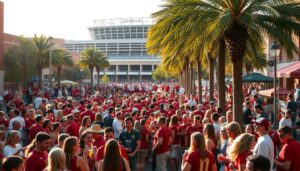
In the Sunshine State, one game is more than just a score. It’s a fight for state bragging rights and pride. It splits families and fires up fans across ages.
The rivalry started in 1958. Now, it’s a national spectacle with big stakes. Every game is a clash of history, pride, and goals.
This intense UF rivalry is filled with unforgettable moments. It’s a story of dramatic finishes and legendary plays. We recall the games that made this rivalry so special.
Early Showdowns and Momentum Swings
The battle for state bragging rights began when Florida refused to play Florida State. The series started in 1958, and the Gators made their mark.
Florida dominated early on. They won five of the first six games. The only tie was in 1961, a 3-3 game. Gators coach Ray Graves called it “a death in the family.” It showed how serious the UF rivalry was from the start.
Florida State’s first big win was in 1964. The game was moved to Tallahassee, and the Seminoles won 16-7. This win was a big moment for FSU, showing they could compete.
Florida then went on a nine-game winning streak from 1968 to 1976. This period included some of the most one-sided games in the series.
The 1973 game in Gainesville was a 49-0 Florida win. This score is the largest margin of victory in the UF rivalry. In 1969, FSU’s offense was shut down, rushing for -18 yards.
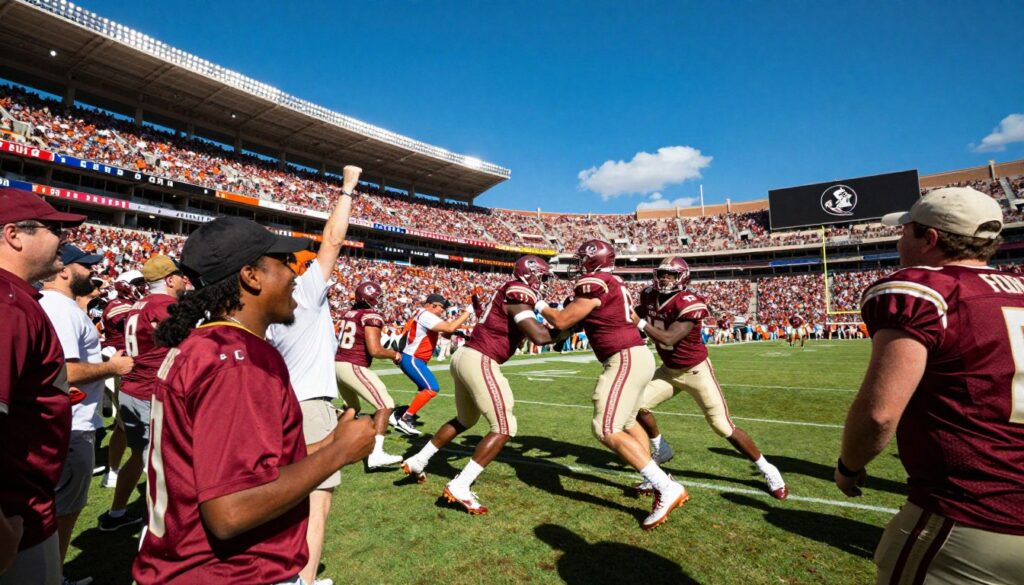
These blowouts gave Florida a big psychological edge. For nearly a decade, the Gators dominated the battle for state bragging rights. From 1958 to 1976, Florida won 16 games, lost 2, and tied 1.
| Year | Location | Winner | Score | Notable Fact |
|---|---|---|---|---|
| 1958 | Gainesville | Florida | 21-7 | Series Begins |
| 1961 | Gainesville | Tie | 3-3 | “A death in the family” quote |
| 1964 | Tallahassee | Florida State | 16-7 | FSU’s First Series Win |
| 1973 | Gainesville | Florida | 49-0 | Largest Margin of Victory |
| 1969 | Gainesville | Florida | 21-6 | FSU Rushed for -18 Yards |
This early period set the tone for the rivalry. It created a deep need for FSU to win in Tallahassee. The early games showed the importance of each game for the state’s pride.
Bowden vs. Spurrier Chess Matches
The rivalry’s most celebrated decade was marked by a personal and tactical duel between Bobby Bowden and Steve Spurrier. For twelve consecutive meetings from 1990 through 2001, their matchups were more than just games. They were high-stakes chess matches with national title implications hanging in the balance.
This era was the peak of the UF rivalry. Both teams were often in the AP Top 10. Six of those clashes featured both squads in the Top 5. Every November, the entire college football world watched to see which legend would outmaneuver the other.
The strategic contrast was stark. Bowden built Florida State into a relentless machine, strong in all phases. Spurrier, Florida’s head coach, revolutionized offense with his “Fun ‘n’ Gun” passing attack. Their games were battles of philosophy as much as physical skill.
| Year | Florida State Rank | Florida Rank | Result | Significance |
|---|---|---|---|---|
| 1991 | #3 | #5 | Florida 14, FSU 9 | Gators’ defense stifles Heisman favorite. |
| 1993 | #1 | #7 | FSU 33, Florida 21 | Seminoles clinch national title path. |
| 1994 | #7 | #4 | Tie 31-31 | The legendary “Choke at Doak.” |
| 1995 | #6 | #3 | Florida 35, FSU 24 | Spurrier’s offense fires on all cylinders. |
The 1991 game set the tone. In a defensive struggle, #5 Florida upset #3 Florida State 14-9. The Gators shut down FSU’s high-powered attack, proving Spurrier’s teams could win with defense too. It was a massive win for state bragging rights.
Two years later, the roles reversed. Top-ranked FSU, led by Heisman winner Charlie Ward, secured a 33-21 victory over the #7 Gators. That win propelled the Seminoles to their first national championship. The victory cemented Bowden’s program at the pinnacle of the sport.
Then came 1994’s immortal “Choke at Doak.” Florida led 31-3 in the fourth quarter in Tallahassee. A miraculous FSU rally forced a 31-31 tie, stunning the college football world. The tie felt like a win for Bowden and a devastating collapse for Spurrier. The teams met again weeks later in the Sugar Bowl, where FSU won 23-17.
The 1995 clash saw #3 Florida’s offense explode. They beat #6 Florida State 35-24, a statement win for Spurrier. It showcased the sheer firepower his system could produce against elite competition.
This golden age defined what the UF rivalry means. It was about more than a trophy. It was about two iconic coaches, their brilliant schemes, and rosters full of future NFL stars. The winner didn’t just get a victory. They claimed ultimate state bragging rights and often, a shot at a national crown. The Bowden-Spurrier chess matches remain the standard by which all future clashes are measured.
The 1996–1997 Trilogy and Beyond
The stakes were incredibly high for 13 months. The national championship and state bragging rights were at stake. This period saw a legendary three-game saga that is the most dramatic in the UF rivalry.
In November 1996, a historic #1 vs. #2 showdown took place in Tallahassee. Florida State, ranked second, stunned the top-ranked Gators with a 24-21 victory. This win seemed to secure the Seminoles’ spot in the national title game.
But college football’s chaotic bowl system had other plans. Other results forced an unprecedented rematch. Weeks later, the same teams met in the Sugar Bowl with the national championship on the line. This time, Steve Spurrier’s Gators unleashed a stunning offensive display.
Florida dominated, winning 52-20. They claimed their first national title and exacted immediate, brutal revenge. The emotional whiplash for both fan bases was immense.
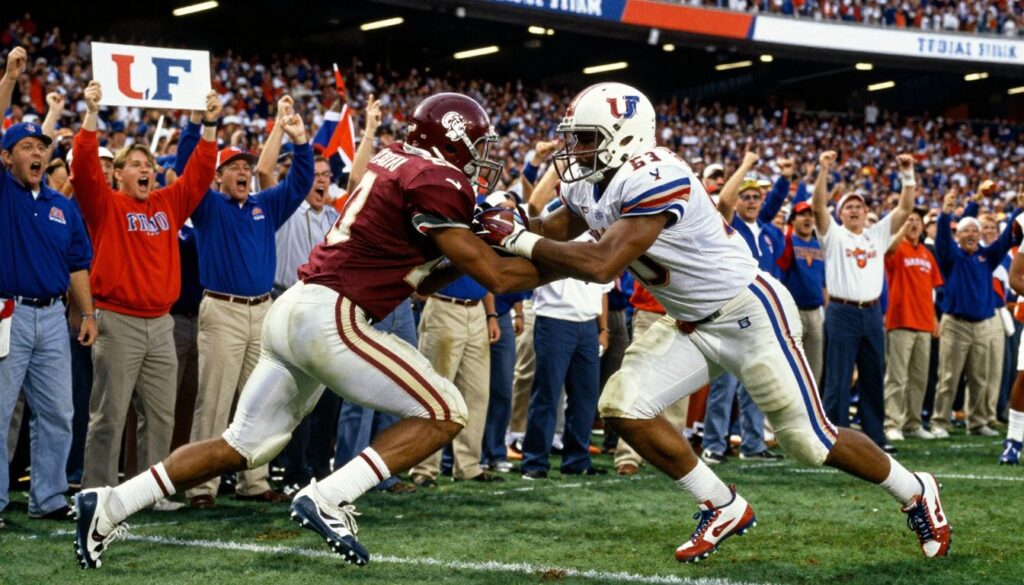
The trilogy ended the following November in Gainesville. Again, Florida State arrived as the nation’s #1 team. The tenth-ranked Gators, fueled by the previous year’s split, pulled off a 32-29 upset. In just over a year, the teams traded monumental wins, defining an era.
This trilogy forever altered the legacy of both programs. It cemented the UF rivalry as a national spectacle with title implications. The battles for state bragging rights had never carried more weight.
After Spurrier’s departure, the rivalry entered a new phase. In 2004, Ron Zook’s unranked Gators upset the fifth-ranked Seminoles in Tallahassee. It was a shocking result that prolonged Bowden’s frustration in the series.
The balance of power shifted decisively with Urban Meyer’s arrival at Florida. His spread offense and relentless teams dominated the matchup. Meyer’s Gators posted a 5-1 record against Florida State.
Key victories came during Florida’s national championship seasons. The 2006 win was a decisive step toward the title. The 2008 victory sealed an unbeaten regular season for the eventual champions. Meyer’s era proved that controlling this rivalry was a cornerstone of national success.
When Bobby Bowden retired after the 2009 season, his final record against Florida stood at 17–18–1. The near-even tally highlighted a career defined by this fierce competition. The series evolved from a chess match to a modern, high-speed conflict, but the core prize never changed.
Ultimate state bragging rights and a path to national glory were always on the line. The 1996-1997 trilogy was the perfect, explosive proof.
Recruits and Legacy Moments Born from the Series
The 21st century brought new chapters to the UF rivalry. Jimbo Fisher’s Seminoles ended Florida’s win streak in 2010. They then dominated with five consecutive victories from 2013 to 2017.
The 2013 37-7 rout propelled Florida State to a national championship. This win was a massive statement for state bragging rights.
Even in lean years, the game’s weight never lightens. The 2017 meeting saw both teams enter with losing records. Bowl eligibility often hangs in the balance, as seen in recent matchups.
The series was even interrupted in 2020 due to COVID-19, proving nothing stops this clash.
Each result directly fuels recruiting wars within Florida’s borders. High school prospects watch these games closely. A win can sway a recruit’s decision, shaping rosters for years.
This perpetual battle for talent is a core part of the rivalry’s legacy.
Florida’s national titles in 2006 and 2008, and Florida State’s in 2013, are forever linked to this series. The Gators hold the all-time series lead at 39–28–2. For a deeper look at the foundational years that built this intensity, explore the history of the rivalry.
The final score is just the start. This game creates iconic moments that live for decades. It defines coaching tenures and fuels fan passion every November.
The fight for state bragging rights never ends, ensuring the Sunshine Showdown’s place in college football lore.