Winning a national title in college football is a huge deal. It’s filled with excitement and high stakes. These games are remembered for years, bringing people together and shaping history.
The Florida State Seminoles have had three standout seasons. They won the national title in 1993, 1999, and 2013. Each win was a defining moment for the team and its fans.
These victories were special because they often came against their arch-rivals. Beating a rival made the win even more meaningful.
This article dives deep into those incredible years. We’ll look at the key games, the legendary players, and the brilliant coaches. Let’s celebrate the unforgettable championship runs of the Florida State Seminoles together.
Why These Titles Matter to Seminole Nation
Before the glory, the Seminoles were overshadowed by the University of Florida. For years, they played second fiddle. But with Coach Bobby Bowden, they started to build something special in Tallahassee.
The 1990s turned this rivalry into a national event. With Steve Spurrier at Florida, both teams were often in the top ten. From 1990 to 2001, winning this game meant a chance at the national title. So, every victory was huge.
The 1993 title was a game-changer. It was Florida State’s first national championship. It wasn’t just a win; it was a new identity for the Seminoles.
This first national championship marked Florida State’s rise as a national power. It wasn’t just a talented team anymore. The rivalry with Florida became even more intense.
These championships built a strong brand for Florida State. They secured a perennial seat at college football’s top table. Fans and recruits saw Tallahassee as a place of legends and titles.
The trophies are more than just awards. They are symbols of community pride and identity. They prove that a program from outside the top can dominate. The 1993 title set the stage for future success, turning hope into reality for Seminoles.
1993: Charlie Ward’s Command and the Defense that Closed
Florida State’s 1993 season was marked by Charlie Ward’s leadership and a strong defense. This was the program’s first consensus national title. It showed the Seminoles as a top force in college football.
Quarterback Charlie Ward was the heart of the team. His skills changed the game. He became the first Florida State player to win the Heisman Trophy.
Ward ran Coach Bobby Bowden’s “Fast Break” offense with skill. He threw for over 3,000 yards and 27 touchdowns. His ability to extend plays kept defenses on their toes all season.
The season highlight was a game against the No. 7 Florida Gators. This was part of the Bowden versus Spurrier rivalry. The No. 1 Seminoles won 33–21.
Ward faced off against Florida’s Danny Wuerffel, another future Heisman winner. Florida State’s win solidified their top ranking. This momentum carried them into the postseason.
The national title game was in the Orange Bowl. Florida State faced the No. 2 Nebraska Cornhuskers. This was under the “Bowl Alliance,” a precursor to the BCS system.
While Ward’s offense was strong, the defense made the final play. Nebraska was leading 18-16 with minutes left. The FSU defense held, forcing a missed field goal to win.
This defensive stand sealed the 1993 title. It was a fitting end for a team often overshadowed by Ward. The championship was won under the Bowl Coalition framework.
This system led to the BCS. FSU’s win proved they could win the biggest prize. The 1993 title solidified their place on the national stage.
| Category | Statistic | National Rank / Note |
|---|---|---|
| Final Record | 12-1 | No. 1 Final AP Poll |
| Key Victory | 33-21 vs. #7 Florida | Secured No. 1 Ranking |
| Championship Game | 18-16 vs. #2 Nebraska | Orange Bowl (Bowl Alliance) |
| Heisman Winner | QB Charlie Ward | 3,032 Passing Yards, 27 TDs |
| Defensive Scoring Avg. | 9.4 Points Allowed Per Game | 2nd in the Nation |
The 1993 team’s legacy is huge. It set a high standard for Florida State. The championship validated Bobby Bowden’s approach and laid a foundation for future success.
Charlie Ward’s Heisman season and the defensive performance are unforgettable. They are the key to Florida State’s first national title. This 1993 title journey is a model for success at the highest level.
1999: Wire‑to‑Wire No. 1 and the Bowden Apex
The 1999 season was a highlight for Bobby Bowden. It was Florida State’s second national championship. This season also marked a key early chapter for the BCS system.
The team had a mix of talent and discipline. Heisman Trophy finalist Peter Warrick was a standout wide receiver. The defense, led by Mickey Andrews, was tough and consistent.
Beating Florida Gators was a big win. It showed the Seminoles’ strength and solidified their top spot. This victory was a key moment in the historic rivalry with Florida.
The Sugar Bowl in New Orleans was the final showdown. It was against No. 2 Virginia Tech and their star quarterback, Michael Vick. The game was expected to be an epic battle.
| Stat Category | 1999 Florida State Seminoles | 1999 Virginia Tech Hokies |
|---|---|---|
| Final Record | 12-0 | 11-1 |
| Final AP Rank | No. 1 | No. 2 |
| Points Per Game | 38.1 | 41.4 |
| Points Allowed Per Game | 16.9 | 10.5 |
| Signature Player | WR Peter Warrick | QB Michael Vick |
Florida State’s defense was the key to victory. While Vick was impressive, the Seminoles’ defense held him back. Chris Weinke led the team to a 46-29 win, securing the 1999 BCS National Championship.
The 1999 team left a lasting impact. It gave Bowden his second title and proved Florida State’s dominance. This was the peak, a season where everything went right from start to finish.
- Finished as the nation’s only undefeated team.
- Won the ACC with a perfect 8-0 conference record.
- Defeated three top-10 opponents (Florida, Georgia Tech, Virginia Tech).
- Captured the program’s second consensus national championship.
2013: Jameis, the Comebacks, and the Final Drive in Pasadena
The 2013 season was a big comeback for Florida State. It was led by a redshirt freshman named Jameis Winston. This season marked the first time the Seminoles were #1 again, finishing 11–0.
Winston, the Heisman Trophy winner, led an incredible offense. His talent and calmness were unmatched for a first-year player.
The team showed great resilience all season. They came back in many games, showing their strong will. These thrilling victories are among the dramatic moments of 2013 that won over fans everywhere.
FSU also dominated in big games. The rivalry game against Florida was a 37–7 win that showed FSU’s strength.
- Record: 14-0 (Perfect Season)
- Final Ranking: #1 (Consensus National Champions)
- Key Victory: 37-7 vs. Florida Gators
- Heisman Winner: QB Jameis Winston
The season ended at the Rose Bowl in the BCS National Championship Game. FSU faced a tough Auburn team. With just over a minute left, Winston led a memorable drive.
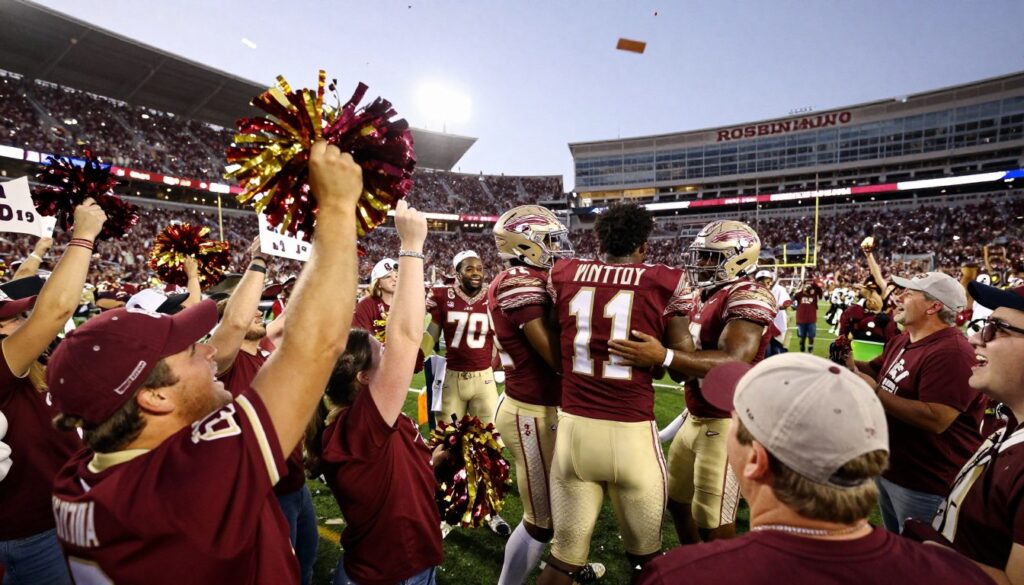
Winston was calm and precise, moving the team down the field. His final touchdown pass with 13 seconds left won the game 34-31. The crowd in Pasadena celebrated a perfect season.
This championship was special. It was the last one under the BCS system. The next season, the College Football Playoff (CFP) started. Florida State’s 2013 win is a highlight between two big eras of college football.
Schemes, Stars, and Turning Points
Florida State’s three national titles show common themes. These include innovative schemes, standout stars, and key turning points. These elements were key to their success in Tallahassee.
The rivalry between Bobby Bowden and Steve Spurrier was a highlight. Their strategic battles shaped college football. Bowden’s offense faced Spurrier’s “Fun ‘n’ Gun” attack, deciding championships.
The offense evolved over the titles. The 1993 team used a pro-style system with Charlie Ward. By 1999, the offense was balanced and controlled games. The 2013 team used a spread attack for Jameis Winston.
Defensive strategies also evolved. The 1993 “Fast Break” defense was known for turnovers. The 1999 defense was disciplined. The 2013 defense was aggressive and supported the offense.
Quarterbacks were key. Charlie Ward’s 1993 Heisman season was unforgettable. Chris Weinke was steady in 1999. Jameis Winston’s 2013 season was historic. Each quarterback lifted the team.
The Florida game was often a turning point. The winner of Florida–FSU played for the national title six times in the 1990s. This rivalry was critical.
In 1993, Ward’s drive beat Florida and gave the Seminoles their first title shot. The 1999 team’s win over Florida solidified their No. 1 ranking. The 2013 team survived a shootout in Gainesville to keep their perfect season alive.
Each championship chase was under a different system. The 1993 title was won under the Bowl Coalition, before the BCS. The 1999 title was won in the first year of the BCS. The 2013 title was won just before the CFP era started.
The table below compares the strategic and personnel elements of each championship run:
| Element | 1993 Championship | 1999 Championship | 2013 Championship |
|---|---|---|---|
| Offensive Scheme | Multiple Pro-Style with QB Run | Balanced Pro-Style, Power Run | Up-Tempo Spread, Vertical Passing |
| Defensive Identity | “Fast Break” Turnover Creation | Fundamental, Gap-Sound Discipline | Aggressive Secondary, Pass Rush |
| Star Quarterback | Charlie Ward (Heisman Winner) | Chris Weinke (Seasoned Leader) | Jameis Winston (Heisman Winner) |
| Key Turning Point | Last-Minute Win at Florida | Road Victory Securing No. 1 Rank | Shootout Survival at Florida |
| Postseason System | Bowl Coalition | BCS (First Full Season) | BCS (Final Season before CFP) |
Each title team had a unique mix of scheme, stars, and turning points. The coaches set up the right system. The players, led by great quarterbacks, executed it. A key moment, often against their biggest rival, pushed them to victory.
The journey from the Bowl Coalition to the BCS and then the CFP was significant. Florida State adapted well to each system. They excelled in whatever was asked of them.
How Each Team Stacked Up Nationally
Florida State’s three championship teams left their mark on college football. Their success wasn’t just about winning. It was about who they beat and how they were seen nationally.
The 1993 team was a game-changer. They faced a world dominated by big, physical teams like Nebraska. Led by Charlie Ward, they played fast and pro-style, unlike anyone else.
Beating Nebraska for the title showed that speed and finesse could top the best. This was before the BCS system unified championships. Florida State’s win over Nebraska marked them as a national powerhouse.
The 1999 team was unstoppable. They were ranked number one all season. This was a testament to their consistent excellence in a crowded field.
Teams like Nebraska and Tennessee were also at their best. The Seminoles’ perfect season, ending with a win over Virginia Tech, showed their dominance. Their defense was among the best in BCS history.
The 2013 team was all about offense. They emerged in a decade where the SEC ruled, led by Alabama. Jameis Winston and the offense set records.
Their comeback win over Auburn in the BCS Championship Game was a turning point. It ended the SEC’s seven-year title streak. This win showed that a high-powered offense could beat the SEC’s physical teams.
The table below shows how each team compared within its national framework:
| Team | Year | National Context | Postseason System | Defining National Trait |
|---|---|---|---|---|
| 1993 Seminoles | 1993 | Era of Nebraska’s power football | Poll Era (Pre-BCS) | The Innovator |
| 1999 Seminoles | 1999 | Peak of BCS-era dynasties | BCS | The Dominant Force |
| 2013 Seminoles | 2013 | SEC dynasty (Alabama, Auburn) | BCS Championship | The Offensive Juggernaut |
Nationally, Florida State’s journey was clear. The 1993 title marked their rise to the top. The 1999 season was their peak. The 2013 championship was a comeback to celebrate.
Each team’s path was shaped by the rules of their time. The pre-BCS poll, the BCS formula, and the final BCS title game all posed challenges. Florida State conquered them all, leaving a lasting legacy.
Legacy for Today’s Program
The three National Championships won by Florida State are more than just history. They are the heart of the program. The standards set by Bobby Bowden and Jimbo Fisher push every coach and player to excel.
This championship history is a big draw for top high school players. It keeps Florida State’s reputation strong in college football. The program’s success is a beacon in a crowded field.
But, the modern era brings new hurdles. Coaching changes followed the 2013 title. Rivalries with Clemson and Miami have seen ups and downs. Under Mike Norvell, the team aims to regain its former glory.
The legacy of the 1993, 1999, and 2013 titles is a roadmap to success. It guides the current Seminoles. This legacy drives them to add to Florida State’s championship history.